29.07. | 20:30 | Church St. Jakob | Opatija
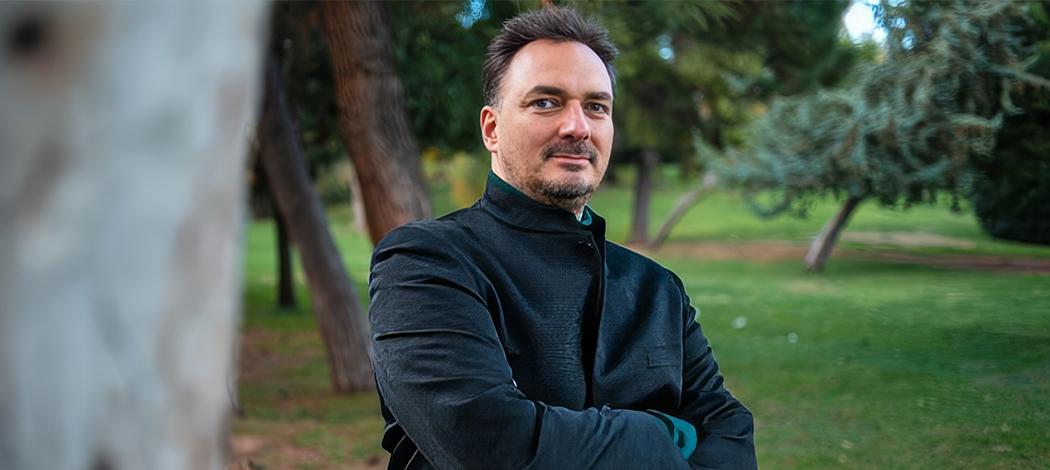
Dimitris Kountouras
Petruslied, anonymous hymn from Germany (9th century)
Inventor rutili, anonymous hymn (12th century)
O frondens virga, antiphon by Hildegard von Bingen (1098–1179)
Victimae paschali laudes, sequence by Wipo of Burgundy (11th century)
Bele doette, chanson, anonymous, trouvère tradition
Agia Marina (Saint Marina), song from Cyprus
Planh (lament), improvisation on a melody by Raimbaut de Vaqueiras
Nina, lullaby from Turkey (19th century)
Tels rit au main, complainte (lament) by Guillaume de Machaut (1300–1377)
I' vo bene, ballata by Gherardello da Firenze (Italy, 14th century)
Virelai by Guillaume de Machaut (1300–1377)
Meditation (1975), Ryohei Hirose (1930–2008)
Pourquoy doux rossignol – L'autre jour ma Cloris, from Airs et brunettes, Jacques-Martin Hotteterre (1674–1763)
Pavane in F-sharp minor for solo harpsichord, Louis Couperin (1626–1661)
Sonata in C major HWV 365, Georg Friedrich Händel (1685–1759): Larghetto – Allegro – Larghetto – A tempo di Gavotta – Allegro
Le sabotier – J'avais cru, anonymous, France, 18th century
L'inconnu, theme and variations on a Menuet by Michel Blavet (arrangement by D. Kountouras)
FREE ENTRY
Dimitris Kountouras
Born in Thessaloniki, Greece, he began his musical training on the recorder and flute with G. Gourdier and I. Macovei. He studied recorder, traverso and Early Music at the Utrecht School of the Arts, in the Netherlands, with H. ter Schegget and W. Hazelzet graduating with a Second Phase performer’s diploma. On a Marco Fodella Scholarship he continued his studies on historical flutes at the Early Music Institute in Milan under M. Gatti and D. Bragetti. Furthermore he concluded his studies on the traverso at the Conservatoire of Vienna and he got a Masters on Medieval Music from the Musikhochschule of Trossingen studying under K. Boeke. He got a PhD on historical musicology from the Athens University and was a post-doc scholar for the Centre of Humanistic Studies (2016) for his original research project “Music and poetry of the Troubadours at the Latin Kingdom of Thessalonica after 1204”.